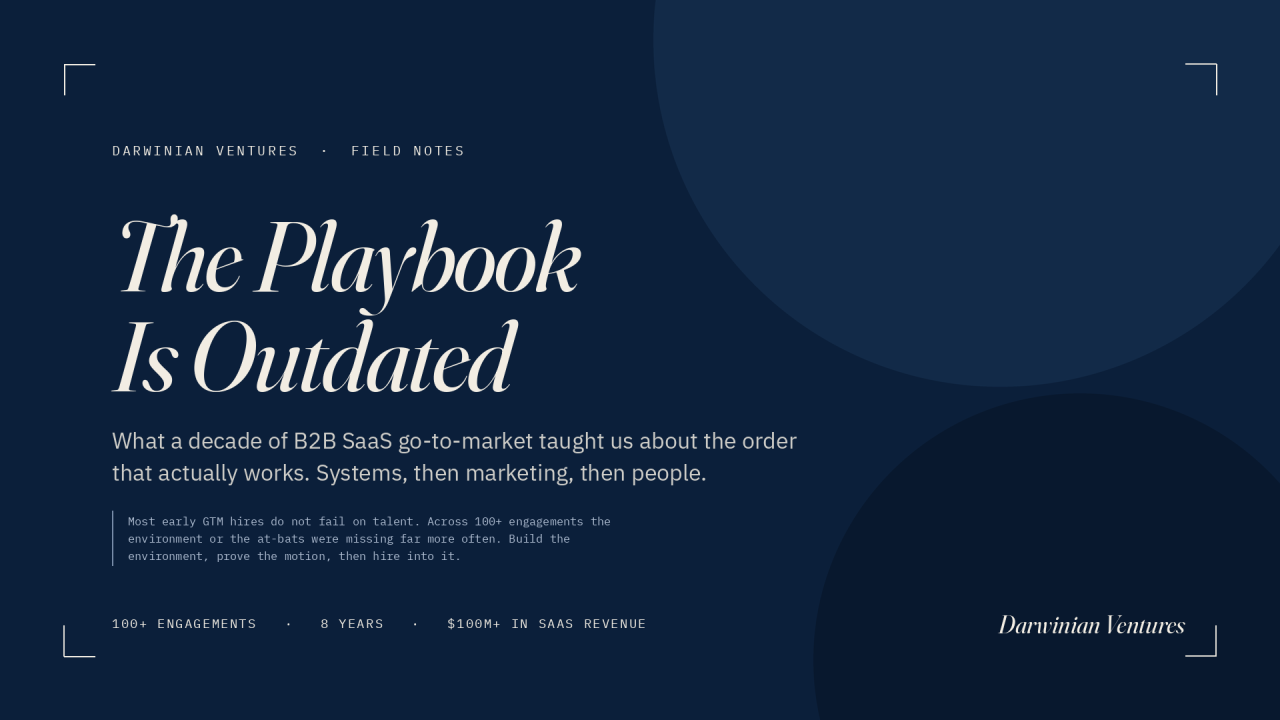
I have spent the last eight years inside early-stage GTM builds. Over 100 engagements, seed through growth stage, across almost every vertical SaaS can touch. The playbook that dominated from roughly 2014 to 2021 produced real outcomes. It produced unicorns. But the conditions that made it work have shifted underneath it, and the founders and operators still running that playbook are not getting the same results from it. This initially sounds like a criticism but is instead a sample size taken from real companies, and the guidelines on how to integrate the findings into your company.
Here is what the old playbook looked like, and it was not wrong for its era. A company raises a round, $2M to $5M, and the first hire is a seller. VP of Sales, senior AE, sometimes both. The logic was sound: you need revenue, go find someone who knows how to close. In 2016 that hire walked into an environment where cold email still worked off a primary domain with no warmup, LinkedIn was not saturated, and inboxes were not yet hostile to outbound. A talented seller with a laptop and a halfway decent lead list could generate meetings on their own. Many did. The playbook said: hire the talent, give them room, and let them figure it out.
That worked because the channels were wide open. The days of AI sending +1M emails a month were far away, but that isn't the case anymore. What has changed is the environment around that playbook. The infrastructure requirements grew while the playbook stayed the same, and that gap is where the failures come from.
Email deliverability became an engineering discipline between 2023 and 2024 as Google and Microsoft tightened authentication requirements. Sending sequences off a primary domain with no rotation, no warmup, no technical layer behind it stopped producing replies. Cold email still works, and it works well, but the cost of doing it correctly went from near zero to a real line item that requires ongoing maintenance. The rules for good email delivery now change almost monthly as new anti-bot filters and spam detectors become increasingly stringent in response to more than half of all internet traffic coming from non-human browsers in 2026.
The cost of a hiring mistake went up with it. Fully loaded, a mis-hire at the AE level now runs $100k to $180k when you account for salary, ramp, and the opportunity cost for a pipeline that resulted in zero new revenue. At $2M ARR that hire is 5% to 9% of total revenue. In 2016 with cheaper talent markets and wider channels you could absorb that hit and try again. The margin for error has compressed in recent years.
In recent years buyers have also changed how they evaluate vendors. The research phase moved to AI-assisted search, peer communities, and self-serve content. By the time someone takes a meeting they have already formed a preliminary opinion about the vendor. The marketing layer, the content, the SEO and what is increasingly called GEO (how you show up inside AI tools), all of that now factors into whether a seller gets the meeting at all.
None of these shifts happened overnight and none of them made the old playbook "stupid". They made it insufficient as a standalone strategy. A talented seller is still the person who closes the deal. What changed is how much has to exist around them before they can get to the conversation with a lead.
Across those 100+ engagements the pattern that shows up most often is not bad sellers. It is good sellers in environments that were never built to support them. No enrichment pipeline feeding the right accounts. No sequences tuned to what is actually landing on calls. No CRM reflecting how deals genuinely move at this company. No deliverability infrastructure. The seller was doing the job of an entire revenue operations team while also being expected to close, and when they did not hit number in four months, the conclusion was usually that the hire was wrong. Sometimes it was a hiring mismatch, more often the work environment was not there yet.
The companies that are getting better results from the same talent pool tend to do things in a different order. They diagnose before they hire, pulling their own pipeline data, call recordings, win/loss patterns, and figuring out where deals actually stall and why. They build the systems layer, the outbound engine, the tooling, the data environment, before they put a person into it. They layer marketing so the paid spend and the organic engine are generating awareness before a seller ever picks up the phone. And then they hire into something that already produces meetings.
This is not the only way to do it. But it is the sequence that has produced the most consistent results in the companies we have worked with, particularly between $1M and $5M ARR where every dollar and every quarter matters.
The difference is not dramatic on paper. It is mostly a question of order. Diagnose, then build, then market, then staff. The founders who spend $7,500 to $15,000 on diagnosis and systems before they commit $150,000 to a hire tend to get more out of that hire. The environment becomes the multiplier.
I am writing this because the conversation I have most frequently is still with a founder who is about to make a $150k sales hire into an empty CRM, not because they are doing it wrong, but because the playbook they learned told them that was the right first move. Ten years ago it probably was. The conditions that made it work are not there anymore.
Early Hires are still as crucial as ever, and the work environment built around those hires have become the deciding factor in successful companies.
For those who have read to the end, here is a link to meet directly with a member of our team to learn more about working with Darwinian Ventures.
Darwinian Ventures helps B2B companies, from founder-led teams through growth-stage companies, diagnose the system, build the operating foundation, and ramp execution under your roof.