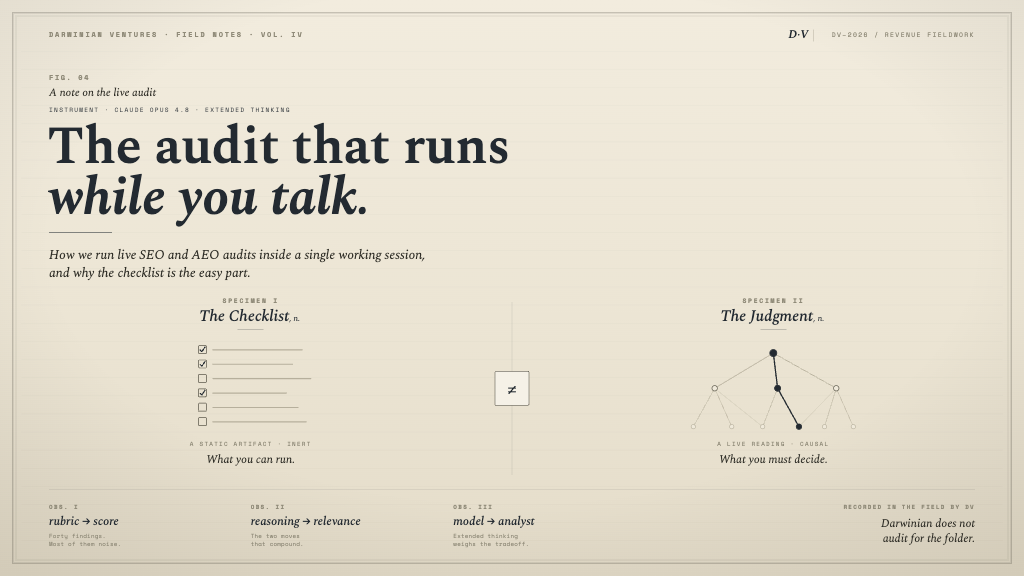
The Audit Used to Be a Deliverable
For most of the last decade, an SEO audit was a thing you waited for.
You hired someone. They pulled crawl data, exported a few dashboards, scored a list of pages against a rubric, and three weeks later you got a PDF. By the time the PDF arrived, half of it was already stale, and most of it described problems without telling you which ones actually mattered to the business you were trying to grow. The document was thorough. It was also inert. It sat in a shared drive, and the team went back to shipping whatever they were already shipping.
That model made sense when the audit was expensive to produce. It is no longer expensive to produce.
With Claude Opus 4.8 running in extended thinking mode, the audit stops being a deliverable and becomes a live instrument. We can point it at a site, a competitor, a single landing page, or a content cluster, and watch it reason through the whole picture in the span of a working session. Not a summary scraped from a dashboard. An actual line of reasoning about why a page ranks, why a competitor gets cited in an AI answer and you do not, and what that means for the next move.
This piece walks through how to run that audit yourself. The full method, not a teaser. By the end you will be able to conduct a real SEO and AEO audit with a tool you already have access to. We will also be honest, near the end, about the part of this that does not come in a prompt.
SEO and AEO Are One Problem Now
Start with the shift, because the shift is what makes extended thinking the right instrument.
For twenty years, the job was to rank. You wanted the blue link near the top of a results page, and you optimized for the crawler that decided the order. That game still exists. It has just stopped being the whole game.
A growing share of buyer research now happens inside an answer engine. A founder asks Google's AI Overview, or Perplexity, or ChatGPT, or Claude itself, a question about a category. The engine reads, synthesizes, and answers. Sometimes it cites sources. Often the buyer never clicks through to anyone. The question is no longer only "do I rank for this query." The question is also "when an AI answers this question for my buyer, does my company show up in the answer, and is it described the way I want."
That second discipline is Answer Engine Optimization. It overlaps with classic SEO and diverges from it in ways that matter:
Classic SEO rewards pages that win a ranking competition. AEO rewards content that an answer engine can lift cleanly, attribute confidently, and trust.
Classic SEO cares about keywords and backlinks. AEO cares about whether your claims are stated plainly, structured legibly, and corroborated elsewhere on the web.
Classic SEO is a position. AEO is a citation.
The reason these two now have to be audited together is that they share a substrate and they trade off against each other in non-obvious ways. A page engineered to win a keyword race can be terrible source material for an answer engine. A page written to be quotable by an AI can underperform on the older ranking signals. You cannot audit one well while ignoring the other. You need a single pass that holds both in view and reasons about the tension between them.
That kind of reasoning, across two partly contradictory objectives, is exactly the work a fast pattern-matcher does badly and a model thinking step by step does well.
Why Extended Thinking, Specifically
A regular model response pattern-matches. You give it a page and a rubric, and it produces a plausible-looking score. The scores are usually fine and occasionally confidently wrong, because the model never actually weighed the tradeoffs. It retrieved the shape of an answer.
Extended thinking changes the operation. The model works through the problem before it commits to an answer. It can hold several competing considerations open at once, test them against each other, fetch and read the actual pages in question, notice when its first read was wrong, and arrive at a position it can defend. For an audit, which is fundamentally an exercise in weighing many partial signals into a judgment, that difference is the whole point.
The practical upshot is that the model stops behaving like a checklist and starts behaving like an analyst. It will tell you not just that a page is missing structured data, but whether that absence is actually costing you anything given how the page is being used. It will tell you that the thin comparison page you were about to fix is fine, and the real leak is three clusters over, in content you thought was working.
A checklist tells you what is technically wrong. Extended thinking tells you what is worth doing something about. Those are different documents.
The Full Method
Here is the whole audit. Run it in order.
Step Zero: Attach the Audit to a Decision
This is the step everyone skips, and skipping it is why most audits are theater.
An audit is not a virtue. It is an input to a decision. Before you pull a single URL, write down the GTM question the audit is supposed to serve. "Should we keep investing in our comparison pages or kill them." "Is our category page getting cited by AI answer engines, and if not, what would change that." "Is organic a channel worth building a system around for this company, or is it a distraction from paid."
If you cannot name the decision, do not run the audit yet. A scored list of two hundred issues with no decision attached is not analysis. It is a way to feel busy.
Step One: Assemble the Inputs
Give the model real material, not a vibe. The richer the input, the better extended thinking performs, because it has more to reason against. A strong input set includes:
The specific URLs in scope, pasted in or made fetchable, so the model reads the actual content rather than guessing from the domain.
Two or three direct competitors' equivalent pages, for relative judgment. Audits in isolation are nearly worthless. Everything is relative to who you are competing with for the position and the citation.
The target queries and, more importantly, the questions a real buyer would type into an answer engine. These are usually phrased as full questions, not keyword fragments.
Whatever you have on the actual buyer: ICP, the language they use, the objections they raise. An audit that does not know who the content is for will optimize for the wrong reader.
Step Two: Run Both Rubrics in One Pass
Have the model score the in-scope content across both disciplines at once. The dimensions that matter:
| Dimension | What you are testing | Discipline |
|---|---|---|
| Crawlability and technical health | Can the page be reached, rendered, and indexed without friction | SEO |
| Intent match | Does the page answer the actual query, or an adjacent one | Both |
| Information gain | Does the page say anything the top results do not already say | Both |
| Entity clarity | Is it unambiguous what company, product, and category this is about | AEO |
| Extractability | Can an answer engine lift a clean, correct claim from this page without distortion | AEO |
| Corroboration | Is the claim supported elsewhere on the web, so an engine will trust it | AEO |
| Structure and schema | Are headings, data, and markup legible to both crawlers and answer engines | Both |
| Competitive position | Against the named competitors, where does this win and where does it lose | Both |
Ask for a score per dimension, the evidence behind each score, and a confidence level. The confidence level is not decoration. It tells you which findings to trust and which to verify before you act.
Step Three: Prompt for Reasoning, Not Verdicts
The quality of the audit lives almost entirely in how you ask. A weak prompt gets you a graded list. A strong prompt gets you an analyst. The skeleton we use looks roughly like this:
You are auditing [pages] for a [company] whose buyer is [ICP],
competing against [named competitors] for [queries / buyer questions].

The decision this audit informs is: [the specific GTM decision].

Read the pages. Score each against the rubric below. For every score:
- cite the specific evidence
- state your confidence
- name what you would need to verify to raise that confidence

Then do the harder thing. Reason about which findings actually
matter for the decision above, which are noise, and what you would
do first if you could only do three things. Argue with yourself.
Tell me where you might be wrong.
The instruction that earns its keep is the last one. Asking the model to argue with itself and name its own failure modes is what converts a confident-sounding output into a trustworthy one. Extended thinking is built to do this. Most people never ask it to.
Step Four: Read the Output Like an Operator
You now have a scored, reasoned, confidence-weighted audit. Do not treat every red cell as a task. Read it for the two or three findings that are both high-impact and high-confidence, and ignore the rest for now. A page that scores poorly on a dimension that does not affect your decision is not a priority. It is a distraction wearing the costume of a priority.
Step Five: Convert Findings Into Moves
The last step turns the audit back into the decision it was built to serve. For each finding you choose to act on, write the move, the owner, and the metric that would tell you it worked. If a finding does not survive that translation, it was never real.
Run this loop in a single session and you have done something that used to take three weeks and produced something worse.
Where the Formula Ends
Everything above is real and it is yours. Run it on your own site this afternoon. We mean that. We would rather you run a sharp audit on yourself than a dull one through someone else, because a company that understands its own funnel is a better company to work with.
But we have written before that the formula is not the force, and this is one more place where the distinction is load-bearing.
The method above is the formula. It is a description of how to produce a good audit. What it cannot hand you is the judgment that decides what to do with one. We have run this exact loop across more than a hundred go-to-market engagements, and the value almost never sits in the audit itself. It sits in the next move, and the next move is a judgment call that the rubric does not make for you.
Consider what the audit gives you and what it leaves open. The audit can tell you that your comparison pages are not getting cited by answer engines. It cannot tell you whether that is because the pages are weak or because the entire category is one where buyers do not use answer engines for that decision, in which case fixing the pages is a waste of a quarter. The audit can tell you that a competitor is winning a cluster. It cannot tell you whether that cluster is worth contesting or whether it is a trap that will cost you six months of content spend to lose politely. The audit can surface forty findings ranked by impact. It cannot tell you that thirty-eight of them are correct and irrelevant to this specific company at this specific stage, because relevance is a function of the GTM motion, the cash position, the sales cycle, and the competitive window, and none of those live in the page data.
The audit is a perceptual instrument. It shows you the terrain. It does not decide where to walk. That decision is made by someone who has walked terrain like this before and remembers how it fails.
This is the work a GTM Engineer actually does. Not running the audit, which is now close to free, but reading it against the live shape of a real business and choosing the two moves that compound instead of the thirty that merely tidy. That reading is built from having been wrong about the same kinds of pages many times, in many companies, and remembering exactly how each mistake announced itself. It does not compress into a prompt, because it is not information. It is judgment under specific conditions, and the conditions are yours.
So take the method. It is a good method and it will make you better. When the audit puts a real decision in front of you and the cost of getting it wrong is a quarter you cannot get back, that is the moment the formula has done its job and the force has to take over. That second part is the part we do.