First a quick introduction/re-introduction:
I'm Andrew Boos. Small-town Canadian, in the SF tech scene since 2011. Founded a handful of companies, exited a couple, invested in a few dozen, advised hundreds of founders on B2B and enterprise GTM. Was CRO of a billion-dollar company at one point, on the hook for putting north of $100M in the bank every year.
What I actually want to write about isn't AI. I'm tired of AI, even when it makes my life easier. It's the older, less fashionable stuff that holds my attention. Community. In-person events. The craft of sales. The psychological gauntlet of building anything that matters. The thing I keep coming back to is that the gauntlet doesn't change much across sales, founding companies, and life in general. The packaging changes. The pressure underneath it doesn't.
When I'm not working, I'm running, cooking, or singing too loudly. Getting married in July, and we're hoping to start a family not long after.
Now the main event...
A Quiet Demonstration
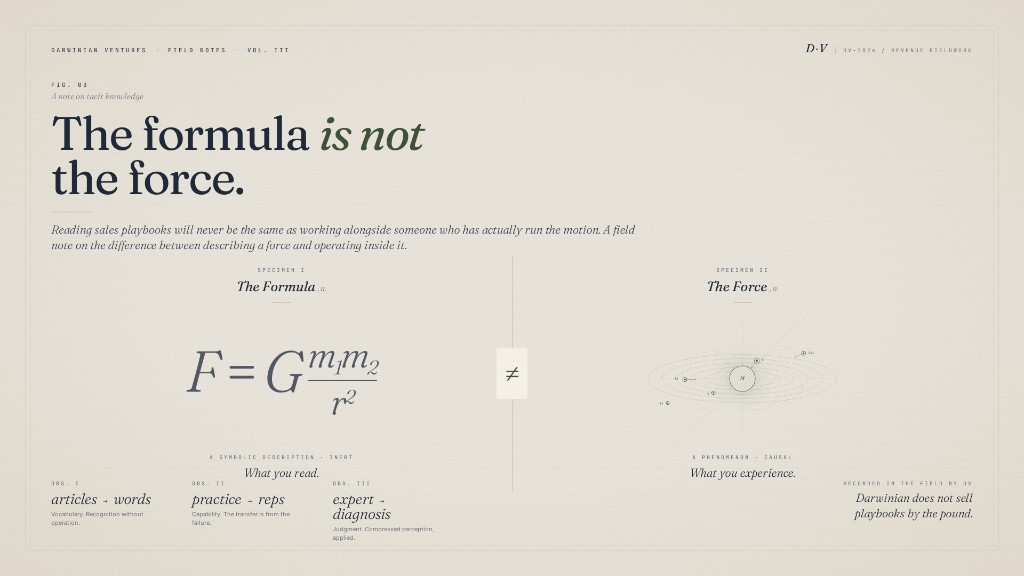
You can write Newton's law of universal gravitation on a chalkboard. F = G·m₁m₂/r². It is a complete description of the force that holds you to the floor right now, that keeps the moon in orbit, that determines the shape of every galaxy ever observed. The equation is correct. It has been verified to absurd precision for three hundred years.
Write it on a board, walk away, and come back tomorrow. The board has not generated any gravity. The marker stroke does not pull the chalk dust toward it. The symbols do not bend the spacetime around the classroom. The formula, written down, does not do the thing the formula describes.
The implication is small but consequential: there is a category difference between describing a force and being inside a force. They are not different points on a continuum. They are different kinds of things.
The reason this matters is that the go-to-market economy has become flooded with descriptions. Sales playbooks. Outbound frameworks. Pricing teardowns. Newsletters explaining the seven things every founder should do to close their next enterprise deal. A whole content layer telling you the formula. And almost nobody is telling you the formula isn't the force.
What Reading Playbooks Actually Gives You
When you read a sales or GTM article, you're receiving a representation of someone else's prior experience. They ran a motion. They tried things. Some things worked. They distilled what worked into a list of rules, framed for a generic reader, stripped of the context that produced them. What you receive is the dehydrated version. Symbolic compression of an actual experience.
This is not worthless. Symbolic compression is one of the most powerful technologies humans have. It's how knowledge moves. It's how you can absorb in a year what took practitioners decades to figure out. The compression is real and the value is real.
But the compression is also lossy in ways that aren't obvious until you try to use it. Reading "build urgency in your discovery call" doesn't give you the thousand small judgments about which urgency moves work for which buyer types. Reading "ask better qualifying questions" doesn't give you the taste required to construct questions that actually shift the conversation. Reading "iterate on your messaging" doesn't give you the calibrated intuition for when a sequence is failing because of the copy versus failing because of the segment versus failing because the offer itself is malformed.
The articles give you the symbols. The symbols are not the force. You can't become competent at GTM by reading more articles, in the same way you can't become a physicist by reading more physics formulas. Symbolic familiarity and operational competence are different categories of knowing.
The Three Categories of Knowing
Three different things keep getting confused under the same word.
The formula gives you vocabulary. You read about MEDDIC, multi-threading, land-and-expand. You can recognize these things when other people are talking about them. You can pattern-match to a known concept. You can ask better questions in your next board meeting.
This is real value. Vocabulary is foundational. You can't operate in a domain whose terms you don't understand. But vocabulary isn't capability. A medical student who has memorized every bone in the body cannot set a fracture. A film student who has read every book on cinematography cannot light a scene. A reader of sales playbooks cannot, when handed a real ambiguous deal cycle, decide which technique to apply, in which order, and how to evaluate whether the application is working.
The practice gives you capability. You sit down and try things. You build, you break, you debug. You watch a sequence go out and produce exactly the response rate you projected, except the responses are coming from the wrong segment, because the segment definition you wrote down was something you couldn't articulate precisely until you saw the wrong version of it.
There's no shortcut to practice and no substitute. People have been pretending there are shortcuts since the invention of the printing press, and the pretense has never once worked. The transfer is not from the article to your brain. The transfer is from the failure to your brain.
The master gives you judgment under your specific conditions. You sit next to someone who has done the practice many times, in many contexts, on many deals that look superficially different but share a deep structure they can see and you cannot. They watch you work. They say something specific. "Stop. Try this." Or, "What you're doing won't work because of x." Or, more often: "You're treating this as a y problem, but it's actually a z problem." In thirty seconds they transfer something that would have taken you a quarter of solo practice to discover, if you ever discovered it at all.
This is the rarest category and the most valuable. It's also the category the playbook economy is structurally incapable of providing, because what the master gives you is judgment under specific conditions. And the specific conditions are yours, not theirs.
A Founder I Sat Across From
I sat across from a founder last quarter who'd done all the homework. He could name every framework. MEDDIC, Command of the Message, the entire catalog. He'd written ICP docs that were better than most ICP docs you'd read on Substack. He'd built a comp plan that looked clean on paper. He just couldn't figure out why none of his deals were closing.
I asked him to walk me through his current cycle. Three minutes in I said, "Your champion isn't a champion. They're an enthusiast. They like you. They have no political capital with the buying committee. You've spent six weeks coaching the wrong person. Switch to the VP of Operations and reset the cycle."
His face did the thing faces do when something they've been staring at for a quarter suddenly resolves.
He had read everything. The reading hadn't given him the diagnosis. The reading couldn't have, because the reading didn't know about his deal. The reading didn't know he existed.
That sentence is worth a hundred articles. You won't find it in any article, because the article doesn't know your specific deal.
The Asymmetry of Real Expertise
There's a particular kind of moment, in any deep domain, that's worth describing precisely because it isn't legible from the outside.
You're stuck on a problem. You've read everything. You've tried everything you can think of. You bring it to someone who has worked in the domain for a long time. They ask three questions. They look at the work for ninety seconds. They say one sentence. The sentence resolves the problem.
To someone who has never seen this happen, it looks like magic. To anyone who has worked in any deep domain, it's the most ordinary thing in the world. It happens every day, in every craft, between mentors and apprentices, between attending physicians and residents, between master chefs and line cooks.
The reason it works is that the master is not running the same algorithm as you, faster. They're running a different algorithm. Through ten thousand hours of pattern exposure they've developed an internal representation of the problem space that lets them see structure where you see noise. They aren't consciously walking through a checklist. They're perceiving a shape.
This isn't mysticism. It's well-studied. Chess grandmasters don't calculate more moves than novices; they perceive better positions. Expert radiologists don't look at more pixels than students; they look at the right pixels. The signature of expertise across every domain isn't raw computational horsepower. It's compressed perception.
You can't get compressed perception from a playbook. The playbook can't transmit it because the playbook is itself a low-dimensional projection of high-dimensional knowledge. The high-dimensional knowledge lives in the master, embodied, accessible only through interaction. Which is why every meaningful skill in human history has been transferred through apprenticeship, even though we've had writing the whole time.
What This Means for Go-to-Market
Building a sales motion at an early-stage company right now is one of the deepest tacit-knowledge domains on the planet. The market context is new. The buyer behavior is shifting. The capital environment is changing quarter over quarter. The failure modes are weird and specific and only learnable through direct contact with weird specific deals.
Which means the gap between someone who has run a hundred-plus motions and someone who has read fifty playbooks is not a small gap. It's a category gap.
The hundred-motion person, looking at your company, can say:
- "You're not going to get traction with this ICP because the buying cycle inside that segment requires a security review you don't have the resources to clear, and you'll burn six months learning that."
- "Your pricing is going to feel right for the first three deals and then collapse on the fourth, because you haven't designed for the procurement function at companies above this size."
- "This is the right motion but the wrong leader. The current rep is closing the deals that would close themselves. You need someone who can run a real cycle, and you need them by Q3 or you'll miss the window."
- "You're treating this as a marketing problem, but the gap is in your sales follow-up. Fix the second one and the first one fixes itself."
These sentences aren't in any article. They can't be. They're diagnoses of your specific situation, and the master has them because the master has seen a thousand specific situations and built a perceptual library of how each one fails.
The Marketplace Has the Trade Backwards
There's enormous market demand for GTM content. Sales newsletters, pricing teardowns, outbound frameworks, webinars, cohorts. The supply has expanded to meet the demand. We are now producing GTM content faster than at any point in business history.
The result, predictable in retrospect, is that the quality of the median GTM article has collapsed. Most of the supply now comes from people who have read other people's articles and are repackaging them. The signal-to-noise ratio is approaching zero. Most of what you read is several layers of compression downstream of the original source, with each layer adding loss.
Meanwhile the actual experts are mostly not writing playbooks. They're working. They're running deals. They're inside the force. The few who do write tend to write in ways that are too specific or too dense or too oriented toward their own context to be the kind of viral-friendly content that wins in the feed.
This produces a market failure. The most accessible content is the least useful. The most useful resources are the least accessible. Six layers down, there is sometimes a person who has actually shipped revenue.
This is why so many early-stage GTM motions fail. The founders have been educated by the formula economy. They've read the descriptions. They haven't been near the force. When they go to deploy, they discover that the force has properties the descriptions did not warn them about. The descriptions were not connected to any actual instance of the force.
How to Spot the Difference
If you want a quick way to tell whether the person in front of you is reading from the formula or working inside the force, here are three honest tests.
Ask them about a failure. Not a polished success story. A real one, where the deal went sideways. People who have run motions have a deep library of specific failures. People who have read about running motions have generic stories that pattern-match to whatever the listener seems to want to hear. The difference is immediately audible.
Ask them to predict. Describe a specific deal you're working. Ask them what will go wrong. People with two thousand hours have specific predictions, made with specific confidence intervals, attached to specific failure modes. People with fifty articles have hedged generalities.
Ask them to disagree with consensus. Every domain has its received wisdom. People who have worked in the domain long enough have at least three things they think the consensus has wrong, and they will tell you what those things are with energy. People who have only read the consensus don't have a non-consensus position because they don't have an inside view from which to dissent.
These tests aren't perfect. People can fake them with effort. But the cumulative signal across all three is strong, and three minutes of real conversation with an expert versus a surface reader is usually enough.
What to Actually Do
The practical core, briefly.
If you're building a go-to-market motion at an early-stage company, the most expensive mistake you can make is to source your education from the formula layer and try to make decisions from there. The formulas are real. The descriptions are real. They're insufficient. Find someone who has done the work. Pay them to look at your specific situation. Pay attention to how they think, not just what they conclude. The judgment is the asset.
If you're trying to upskill yourself, read the articles. They aren't useless. Just don't stop there. Pick a real motion in your actual company. Try to run it. Fail. Notice why you failed. Try again. Find someone who has done it before and have them look at your work for thirty minutes. Repeat. The articles give you vocabulary. The work gives you capability. The expert gives you judgment. You need all three, in that order, and the only one of the three you can buy in a single transaction is the third.
If you're leading a board through a GTM transition, the structural move is to internalize the difference between formula and force at the level of how you allocate budget and authority. Most companies under-spend on actual expertise and over-spend on tooling and content. The math is wrong. One person who can see the structure of your sales motion is worth more than ten thousand articles describing sales motions in the abstract. Hire accordingly.
Closing
The chalkboard does not generate gravity. Everyone knows this.
The article does not generate capability. Once you see this clearly, you stop expecting it to. You stop reading the next playbook hoping that this will be the one that finally transforms your sales motion. You start looking for the people who have done the work, and you start spending real money to get into a room with them.
The formula is not the force.
If you're building a go-to-market motion right now and want to talk to someone who has done it before, that's what we do at Darwinian Ventures.