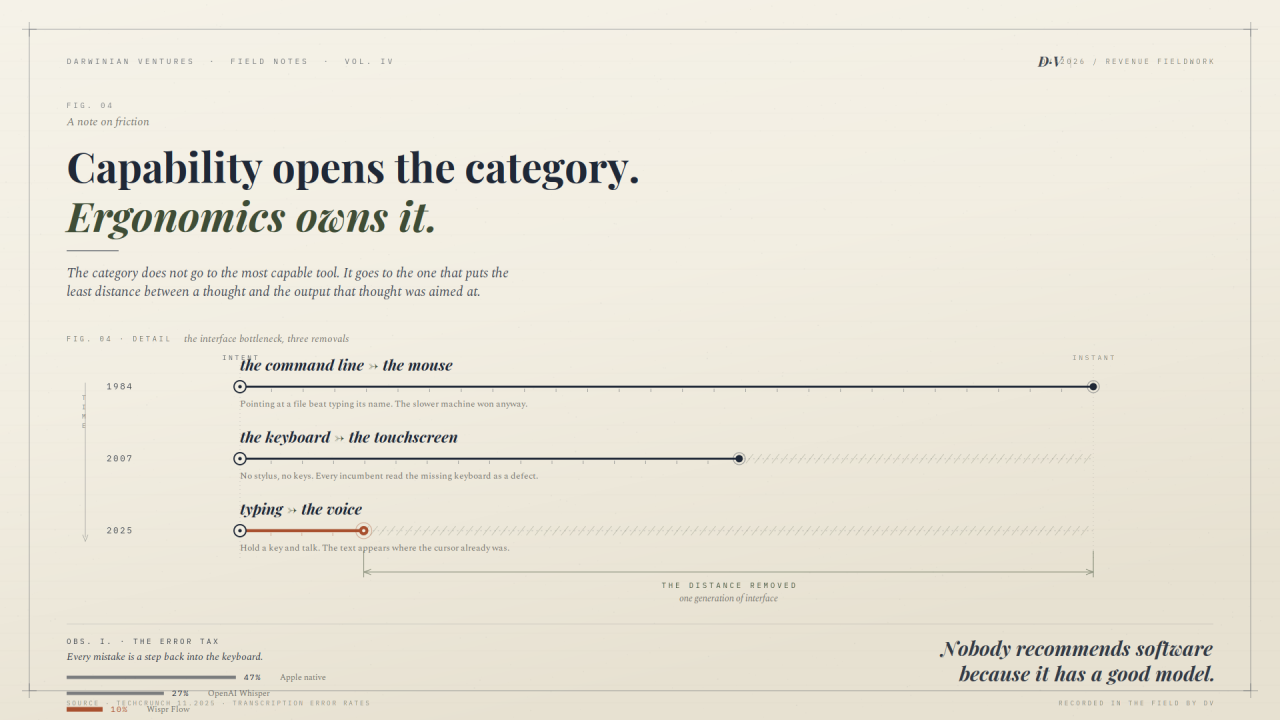
Ergonomics, in software, is the friction between intent and output. How many steps sit between a person having a thought and the machine producing the thing that thought was aimed at. How much of your own thinking you have to translate into a format the system will accept before it will cooperate. Every tool charges this tax.
Apple has been running this playbook for forty years. The mouse and the graphical interface beat the command line on machines that were slower than the ones they replaced, because pointing at a file is a shorter path than typing a command that describes the file.
In 2007 the iPhone shipped without a stylus and without a physical keyboard, which every incumbent read as a defect, and the touchscreen won because it deleted a friction point. Apple rarely had the best components. It had the shortest path from intent to action, and that is what produced the adoption and the pricing power that followed. The specs were what the competition talked about. The ergonomics were what people actually experienced.
The same gap has opened again, in a different place.
AI Models got extraordinarily capable in about thirty-six months. The way humans feed them did not change. You still type. On the other side of that keyboard is a system that can produce a page of text in under a second and spends most of its existence waiting on a human's fingers. The bottleneck moved. It is no longer in the machine, it is in the interface between the person and the machine, which is roughly where the bottleneck sat in 1983 before the mouse and in 2006 before multitouch.
Wispr Flow is the clearest current example of what happens when someone removes friction.
Wispr Flow is voice dictation that runs across any application on your machine. Hold a key, talk, and the text appears where the cursor already was, punctuated and formatted in the register you were writing in. No separate app, no window to switch to, no export step, no cleanup pass. What the product removed is the translation layer between having a thought and having that thought exist as text. The adoption numbers look like what happens when a translation layer is removed, not like what happens when a feature ships.
TechCrunch reported in November 2025 that after three months of use, the average Wispr Flow user was writing more than half of their characters through the app. That is not a tool people are trying. That is a tool that has replaced a motor habit most users have had since they were eleven. At that point the company was growing about 40% month over month, signing roughly 125 companies a week as enterprise customers, and had reached 270 of the Fortune 500, on a headcount of 94.
The interesting part is that the friction is measurable. Wispr claims an error rate around 10%, against roughly 27% for OpenAI's Whisper and about 47% for Apple's native transcription. Those are not abstract quality scores. Every error is a correction the user has to make by hand, and every hand correction is a step back into the keyboard, which is the exact friction the product exists to eliminate. At 47% you are proofreading. At 10% you are talking. The distance between those two numbers is the whole product.
The market moved on it accordingly. TechCrunch reported a $700 million post-money valuation in November 2025 on roughly $81 million raised. In May 2026 Bloomberg reported the company was in talks to raise about $260 million at a valuation near $2 billion, led by Menlo Ventures. That round was reported as in talks and not closed, and it is worth holding loosely. The direction is still not ambiguous.
What Wispr does not have is a defensible model. It runs a mix of in-house and third party speech models, the same raw material anyone in the category can buy or rent. Its advantage is interface, latency, and polish, which is another way of saying its advantage is ergonomics. In a market where the underlying intelligence is a commodity that gets cheaper and better for every competitor at the same rate it does for you, the only thing that compounds is the distance you removed.
That distance is also what makes the thing spread. Nobody recommends software because it has a good model. People recommend software because using it stopped costing them something. A user who is producing half their written output through a dictation tool inside of three months is not a satisfied customer, they are a dependent one, and dependence is what moves a personal tool into an organization. It explains how enterprise logos accumulate at 125 a week at a company with 94 employees. The ease of use is doing work that would otherwise require a sales team.
There is a pattern worth naming here, and it is older than any of these companies. Capability creates the possibility of a category. Ergonomics decides who owns it. The command line could do everything the Macintosh could do and more, and it lost the consumer market anyway. Physical keyboards were more accurate than the first iPhone keyboard, and they are gone. Whisper is free, and Wispr is not, and the paid one is the one people are using for half of everything they write.
The thing that gets missed is that this is not a design conversation, or at least it does not stay one. Friction is what a person actually experiences when they use a product, and experience is what gets repeated, and repetition is what turns into habit, adoption, retention, and eventually a valuation. The path runs in that order and it does not skip steps. Capability sits upstream of all of it and gets most of the attention anyway, because capability is easier to demo and much easier to put in a deck.
Every generation of technology has a bottleneck sitting between the person and the machine. Someone eventually removes it, and the removal looks small, a mouse, a fingertip, a hotkey you hold while you talk.
Sources: TechCrunch, November 20, 2025, on Wispr's $25M round, growth metrics, error rates, and $700M valuation. Bloomberg, May 12, 2026, on the reported $260M round at a valuation near $2 billion.