A founder we worked with last year did what the moment seemed to ask. He bought the tools and pointed them at the top of the funnel. Within weeks his outbound had multiplied close to tenfold, and the activity charts turned the reassuring green that makes a board update easier to write. Two quarters later, revenue had not moved, and nobody could say why. The dashboards were no help. They measured how much the machine was doing, never whether any of it was working.
Some version of this crosses our desk most weeks now, and the obvious reading of it is wrong in a way that costs a founder about a year.
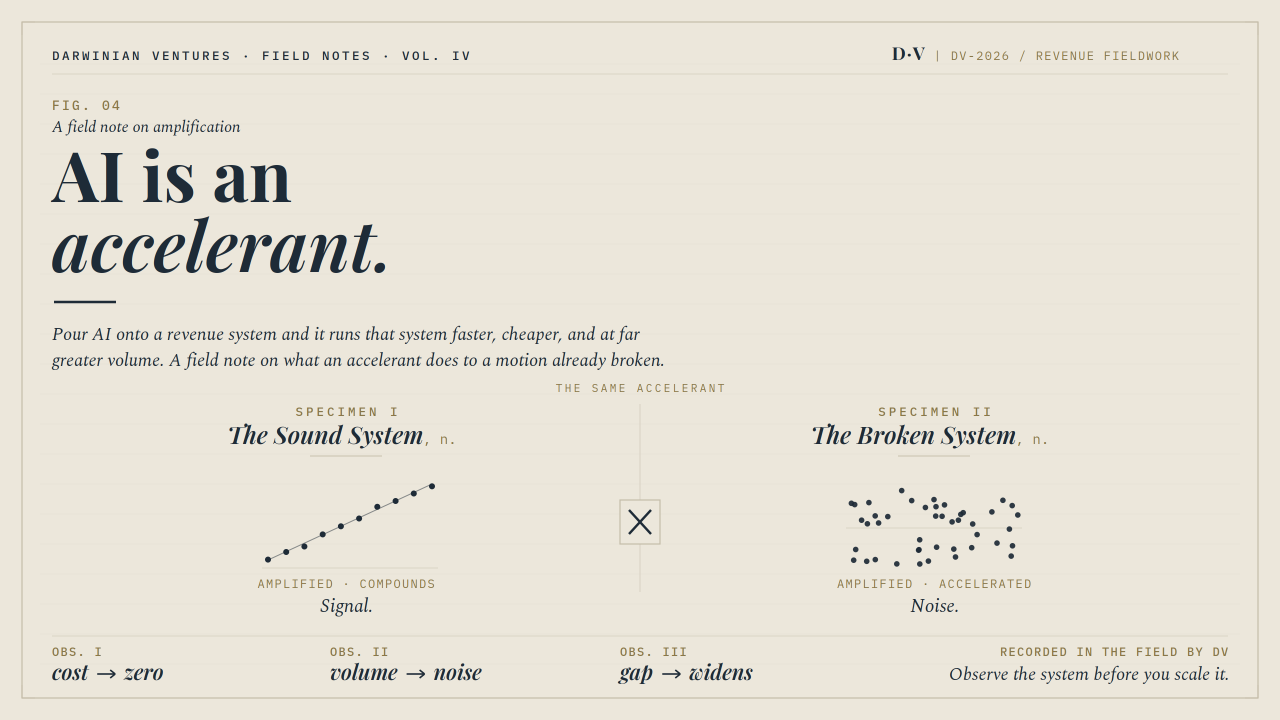
AI does not fix go-to-market. It accelerates it. It holds no opinion about whether your ICP is right or your message lands. It takes the system you give it and runs that system faster, cheaper, and at far greater volume. Pour it onto a motion that works and it compounds. Pour it onto a broken one and it scales the waste just as cleanly.
The quieter damage is in what cheap motion takes away. When outbound was expensive, a wrong ICP announced itself fast, as a rep's wasted month and a burned budget. The expense was a smoke detector. It went off early and made you check the stove. AI drove the cost of motion toward zero and disconnected the detector. The waste is still there, all of it, but it no longer hurts this quarter, so nothing forces you to look. A dysfunction that once corrected itself inside a month can now run, fully funded and invisible, for the better part of a year.
The dashboards fill while it does. More sent, more booked, more of what everyone agrees to call pipeline. Volume reads as progress, and AI is exceptional at volume. But the conversion truth underneath is unchanged or worse, and a CRM that could not tell you which segment converts a year ago still cannot, now across ten times the noise. It is a machine for manufacturing expensive noise that looks, on a chart, exactly like learning.
So AI does not close the gap between a good revenue system and a bad one. It widens it. Two companies that looked alike eighteen months ago, one with a sharp ICP and a CRM that tells the truth, the other with motion and hope, take the same accelerant in opposite directions. The separation gets read as a story about who adopted AI faster. It almost never is. It traces to who fixed the environment before amplifying it.
What changed is the cost of execution, the lists and sequences and follow-ups, the part that was always cheap and is now free. What did not change is the cost of judgment: who the customer is, what to say, which motion fits the stage. When execution gets fast enough, its speed is easy to mistake for proof that the judgment underneath is handled. It is not. It is just buried under output.
The move is the one it always was, with higher stakes. Observe the system before you scale it. Audit, ICP, message, CRM, cadence, then motion. AI belongs at the end of that sequence, aimed at something that already works. Run it earlier and you are paying, very efficiently, to scale something you have not yet understood.