A growing share of B2B research now starts with a question to an AI assistant instead of a search engine. A buyer asks which GTM agencies to consider, or when to hire a fractional CRO, and gets back a short answer naming three to five companies.
That answer has no page two. Companies named in it enter the consideration set before any website gets visited. Companies left out of it don't lose the click, they never existed in the buyer's process at all. Which makes the operative GTM question for the next few years fairly blunt: when the machines assemble an answer about your category, do they have anything of yours to cite?
For most companies the honest answer is no, and not because the content doesn't exist. This summer we tested one of the cheaper ways to fix that, on ourselves.
What Stacklist is
Stacklist is a hosted public page where a company collects links to everything it has published, organized by topic. Ours is live at stacklist.com/darwinian.
Each link is a card: a podcast episode, a blog post, a press mention, a profile. Cards group into stacks by topic. On the DV hub, that means a stack called "Darwinian in Conversation" holding every podcast we've appeared on, "The GTM Tech Stack" holding our tooling breakdowns, and "When to Hire a Fractional CRO" holding exactly what the name suggests.
No new content gets written. Material that already exists, scattered across Medium, YouTube, other people's podcasts, and your own blog, moves onto one page sorted by the questions buyers ask.
Described that way it sounds almost too simple to matter. The reason it matters is in how the machines read it.
Why this works on AI systems when your website doesn't
Three mechanisms, all visible in our own data.
The pages are built to be parsed. Every Stacklist stack and card is a server-rendered page with a clean canonical URL, its own description, and structured metadata. Most marketing sites are the opposite: JavaScript-heavy, organized around the company's own navigation, and carrying migration scars. In our site audits the pattern repeats constantly, especially after a replatform: FAQ pages returning soft 404s, legacy content indexed under dead URLs, structured data nobody owned. A crawler hitting that site gets fragments. A crawler hitting a hub gets a clean, topic-organized index of everything the company has.
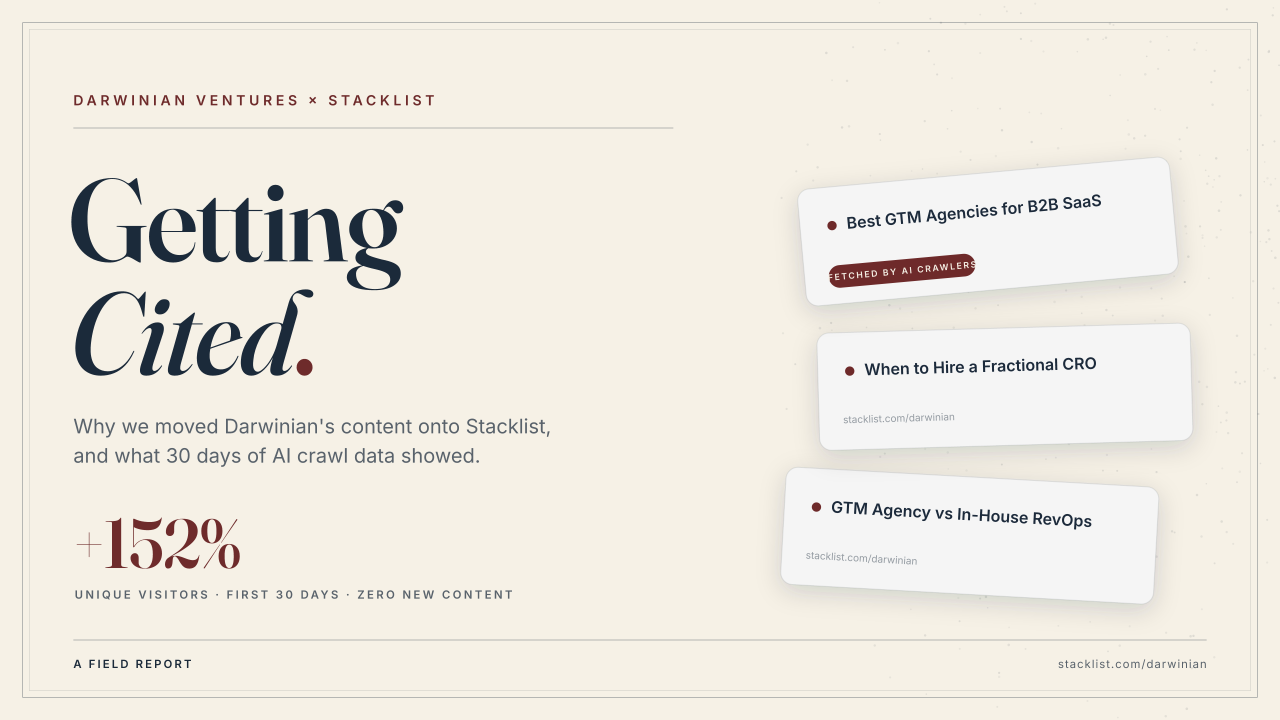
Cards get named like buyer questions. This is the part most people miss. A stack or card title can be the query itself. Our hub's crawl log for the last 30 days shows AI crawlers fetching cards titled "Best GTM Agencies for B2B SaaS," "GTM Agency vs In-House RevOps," "How to Fix a Broken GTM Strategy," and "First Sales Hire Guide for SaaS Founders." Those are not blog posts we wrote. They're shelf labels we put on existing material, phrased the way a buyer phrases the question, and the systems that answer those questions are pulling them. You get a page per buyer question without building a content site.
The Stacklist links outward, so it compounds. Every card points back at your actual properties: your site, your YouTube, your episodes on other people's platforms. The hub functions as a citation layer sitting on top of everything you've made. One of our clients, a regional startup publication, now adds their stack links into editorial as they publish, which produces real backlinks from a media domain, the kind SEO teams spend genuine budget acquiring.
What it produces when it works
The results below are from client accounts we work on, further along the curve than we are.
A luxury real estate agent's hub now appears second in ChatGPT's answer for "top luxury real estate agents in Atlanta." She has since worked with a $15M buyer who found her through ChatGPT, and her hub views grew 570% in a 30-day period. Her hub gets active fetches from GPTBot, Claude, and Meta AI, meaning her content sits inside the systems answering her buyers' questions.
Another client's four hubs drew roughly 26% more traffic than the company's own website over the same period, on the same content. A dev-tools client's utilities stack is served inside ChatGPT answers today, and that single fact anchors the account's renewal case.
None of these companies produced new content to get there. Each one re-shelved what existed.
Our own first 30 days, honestly
We stood up the DV hub in mid-June and published nothing new. Unique visitors rose 152% while total views rose 22%, and that gap is the early signal worth watching: new people reaching the content, not an existing audience returning more often. Our oldest assets led, with the podcast archive alone driving about a fifth of hub traffic.
AI and crawler visits rose 145%, and we'll give that number the context most vendors won't: the bulk of it is crawlers, including SEO tools we run ourselves, with genuine AI assistants still a small fraction. That's the expected shape of month one. Crawlers index first; citations in answers follow on a timeline of months, which is exactly the arc the client accounts above traced before their results landed.
Overall
Companies with a few years of history are sitting on a library that cost real money to produce and is invisible to the systems buyers now ask first. Getting that library cited doesn't require an agency GEO retainer or a content team; it requires re-shelving what exists onto pages the machines can actually read, labeled with the questions buyers actually ask.